
Karen Horney wrote about alienation from oneself, the tyranny of internal “shoulds,” and the search for one’s true self. In 2025, while editing this text during a full-scale crisis, I realized: she was writing about us

The meaning is bitter and true. Just like chocolate.
This book by Karen Horney (in Ukrainian) explores how we become our own harshest critics. Written in 1950, it reads as if it were speaking directly to us today. About pride, which both protects and destroys. About the inner tyranny of “must,” which wears us down more than any external demand. About how to return to your true self, if you even remember who that is.
I edited this text by a brilliant rebel in the field of psychoanalysis. I was responsible for ensuring terminological accuracy and adherence to the psychoanalytic tradition. I wrote scholarly notes—over 75,000 characters—and a foreword—over 38,000 characters.

"Neurosis and Human Development.
The Thorny Path to Self-Actualization"
The book was published in 2026 by VERBA Publishing as part of the “Classics of Psychology” series.
The book on the Verba Publishing website, Kharkiv
- 544 pages
- hardcover
- translation: Yevhen Miroshnychenko
- editing, scholarly editing, foreword: Tetiana Stanislavska
- ISBN: 978-617-8662-41-7
490 UAH
+ shipping
I include a postcard in every book with a heartfelt message from me personally. Since the book deals with neurosis, the tyranny of “shoulds,” and the search for one’s true self, this message is anything but formal.
Horney doesn’t promise honey. She promises honesty. That’s why the card will be a small, personal hint on the path to finding yourself. Be careful: it might just come true.
What is the book about?
- How an idealized self-image is formed;
- What the “pursuit of fame” and the system of pride are;
- How the tyranny of internal “musts” works;
- Why setting excessively high standards for oneself does not always promote growth;
- How neurotic expectations affect relationships;
- Why self-hatred is the flip side of pride;
- How a person becomes alienated from their own feelings and desires;
- What Karen Horney calls the “real self”;
- How returning to oneself becomes the foundation for true growth.
Excerpt from the Foreword (in Ukrainian)
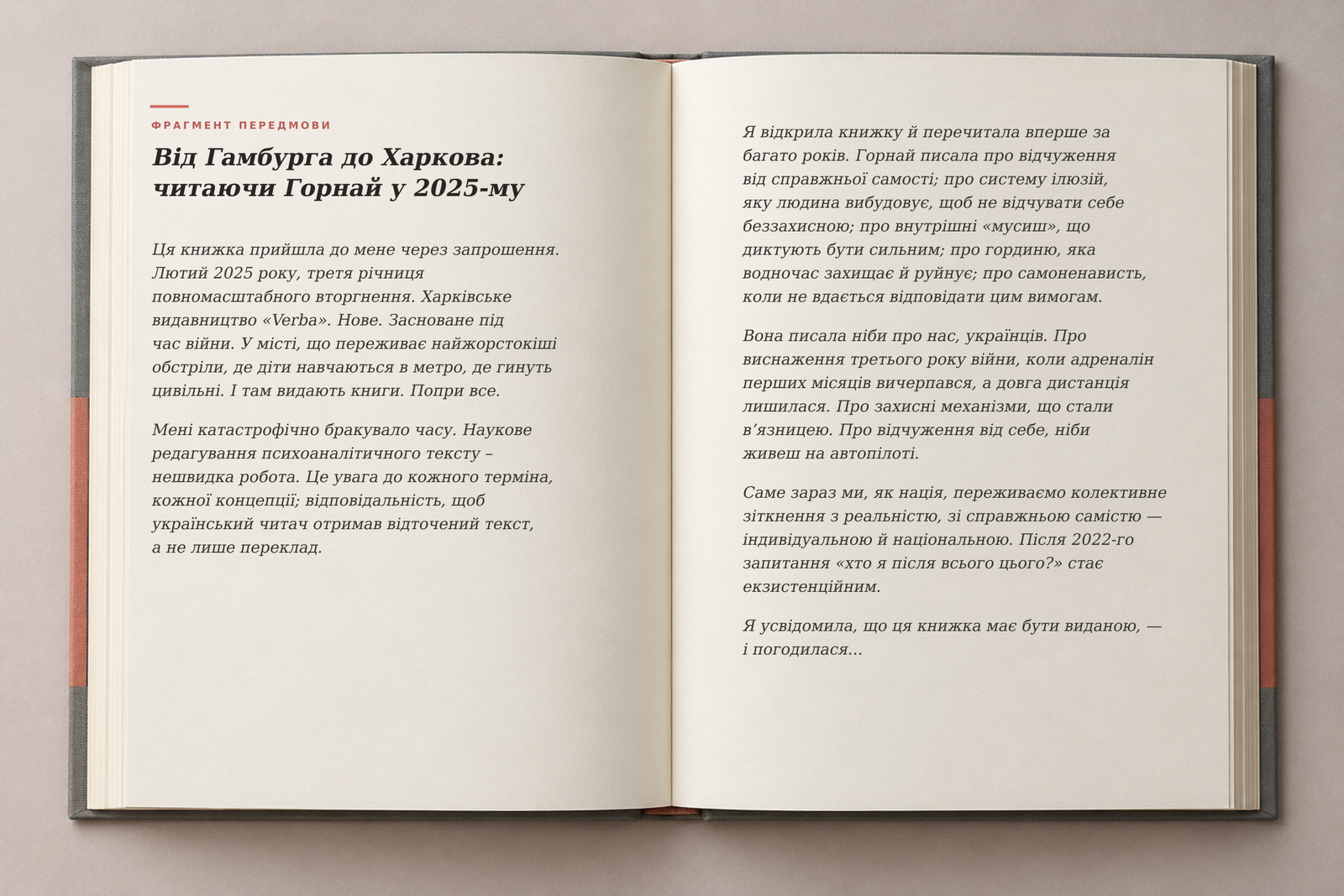
Click to read an excerpt from the foreword
From Hamburg to Kharkiv: Reading Horney in 2025
This book came to me through an invitation. February 2025, the third anniversary of the full-scale invasion. The Kharkiv publishing house “Verba.” New. Founded during the war. In a city enduring the most brutal shelling, where children attend school in the subway, where civilians are dying. And yet they publish books there. Despite everything.
I was desperately short on time. Scholarly editing of a psychoanalytic text is not a quick job. It requires attention to every term, every concept; a responsibility to ensure that the Ukrainian reader receives a polished text, not just a translation.
I opened the book and reread it for the first time in many years. Horney wrote about alienation from one’s true self; about the system of illusions that a person constructs to avoid feeling vulnerable; about the internal “musts” that dictate one must be strong; about pride, which both protects and destroys; about self-hatred when one fails to meet these demands.
She wrote as if she were writing about us, Ukrainians. About the exhaustion of the third year of war, when the adrenaline of the first few months has worn off, but the long haul remains. About defense mechanisms that have become a prison. About alienation from oneself, as if living on autopilot.
Right now, as a nation, we are experiencing a collective confrontation with reality, with our true selves—both individual and national. After 2022, the question “Who am I after all this?” becomes existential.
I realized that this book had to be published—and I agreed.
This book will be helpful
- psychotherapists, psychoanalysts, and psychiatrists;
- psychologists and other professionals in the helping professions;
- faculty and students in psychology programs;
- people who place high demands on themselves;
- those who live under the pressure of self-criticism;
- anyone who wants to better understand their own conflicts and reconnect with a more vibrant and authentic version of themselves